AI Agents vs AI Workflows (AI Automation)

The conversation around AI is moving fast, and with it, the language used to describe how machines perform tasks. Terms like AI automation, AI workflows, and AI agents are often mentioned together. At first glance, they may appear to be similar, but they point to different ways of applying intelligence in business and technology.
This article explains the distinction between AI workflows and AI agents, outlines their strengths and weaknesses, and provides guidance on when each should be used. It also highlights how both can be combined to create more powerful systems.
What Are AI Workflows and AI Agents?
AI Workflows (AI Automation)
AI workflows are structured pipelines in which each step is predefined by human design. Clear inputs, explicit rules, and human oversight are required. While large language models (LLMs) can be included to improve flexibility, workflows remain rigid and deterministic.
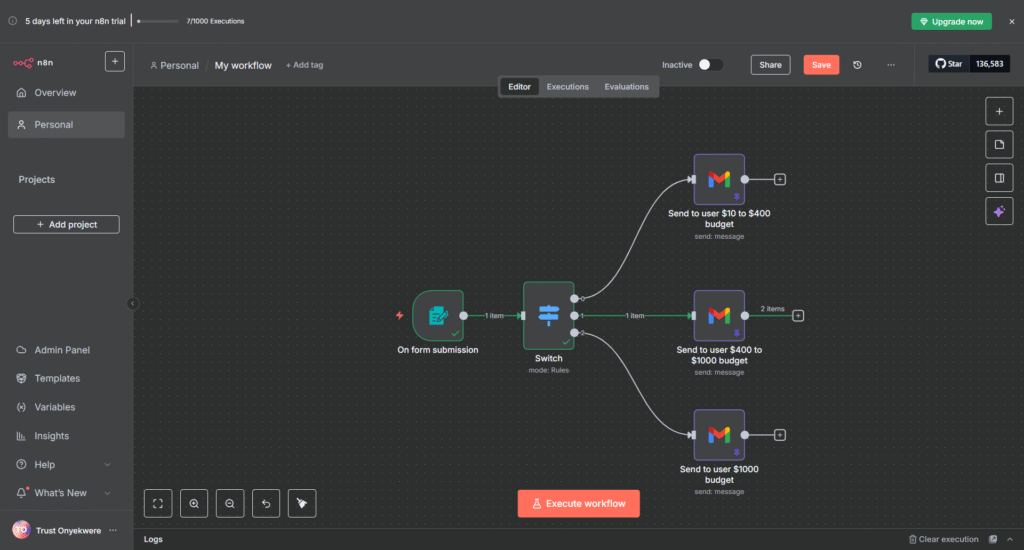
Example: In the first image above, a workflow is shown using n8n. The process starts when a form is submitted. The workflow then passes through a Switch node, where rules are applied. Depending on the budget entered in the form, different actions are triggered. If the budget is $10–$400, one type of email is sent. If it is $400–$1000, a different email is triggered. For budgets above $1000, another branch of the workflow sends the appropriate message.
This illustrates how workflows operate: predefined rules decide the next action. The system does not adapt or improvise beyond the instructions it was given.
AI Agents
AI agents are systems designed to function with autonomy. Goals are interpreted, plans are created, and tools are applied to complete multi-step tasks—even when inputs are uncertain. With LLMs, agents can decide dynamically what steps to take without requiring detailed instructions in advance.
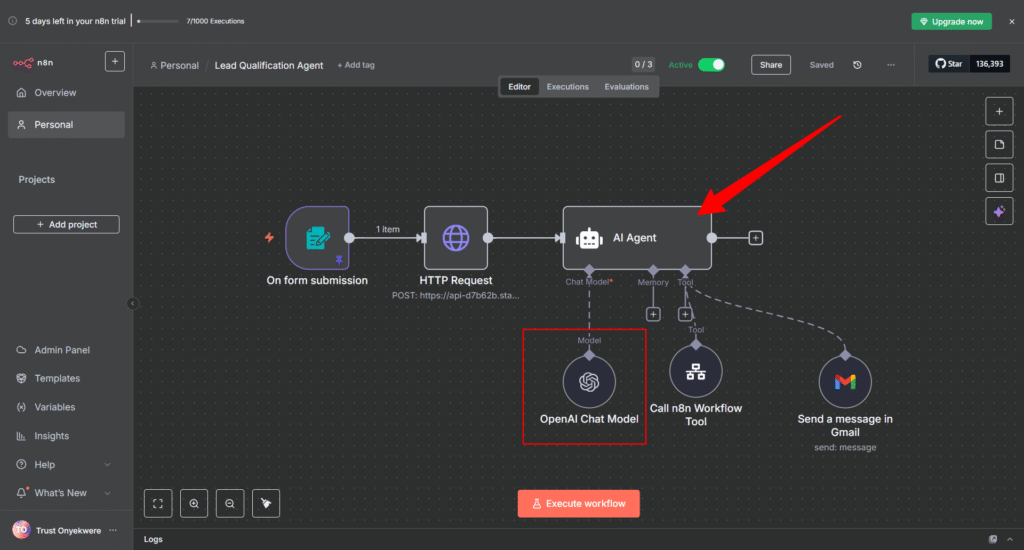
Example: In the second image above, another n8n setup is displayed. Here, a form submission triggers an HTTP request, which then passes into an AI Agent node. The agent is connected to an OpenAI chat model and additional tools. Instead of simply following rules, the agent can analyze the form data, interpret intent, decide which tool to use, and determine whether to respond with an email, call another workflow, or take another action.
Unlike the fixed routing of workflows, the AI agent introduces reasoning and adaptability.
Key Differences
| AI Workflows (Automation) | AI Agents | |
| Decision-making | Predefined logic; low autonomy | High autonomy, dynamic reasoning, and planning |
| Adaptability | Limited; suitable for predictable cases | Strong; can adjust strategies in real time |
| Explainability | Transparent and auditable | Often less transparent (black-box reasoning) |
| Best Use Cases | Standardized, repeatable tasks | Open-ended, complex, or fuzzy tasks |
| Maintenance | Updates required when rules change | Training or reinforcement needed |
Workflows remain valuable where consistency and compliance are required. Agents are more suitable in environments where inputs vary and flexibility is needed.
When to Use Each Approach
Workflows Should Be Used When:
- Tasks are repetitive and predictable.
- Results need to be auditable and explainable.
- Efficiency at scale is the main requirement.
Agents Should Be Used When:
- Inputs are unstructured or ambiguous.
- Adaptability and planning are needed.
- Natural language interaction or tool orchestration is central.
- Branching decisions and reasoning are required.
Pros & Cons
| Pros | Cons | |
| AI Workflows | Predictable, auditable, efficient, easy to control | Inflexible, brittle to change, limited adaptability |
| AI Agents | Autonomous, adaptable, capable of complex reasoning | Less transparent, harder to debug, and potentially unpredictable |
| Hybrid Approach | Structured yet adaptive, optimized for evolving scenarios | More complex to design and maintain |
Conclusion
The choice between AI workflows and AI agents should not be viewed as a strict either/or decision. Workflows are best when reliability, compliance, and repeatability are required. Agents are best when adaptability, reasoning, and tool use are needed.
In practice, many organizations will need both. Routine processes, such as form-based routing or automated emails, are best left to workflows. More complex processes, such as lead qualification or customer query handling, are better suited to agents.
The future of AI in business will likely be built on hybrid systems where workflows provide stability and structure while agents provide intelligence and adaptability. By combining both approaches, organizations gain the predictability of workflows and the flexibility of agents. This combination allows businesses to handle both routine and complex tasks effectively, creating systems that are reliable, scalable, and adaptive to real-world challenges.