Case Study: Automating Lead Qualification with AI Agents in n8n

Case Study by Trust Onyekwere
B2B service-based businesses often struggle with qualifying inbound leads. Sales teams spend countless hours reviewing form submissions, visiting websites, and manually deciding if a lead is worth pursuing. This slows down response times and leaves room for errors.
We wanted to explore whether a low-code AI Agent could automate this process, screening leads instantly and notifying the right people, while still being simple enough to maintain. This is part of what we’re experimenting with at Apptalic Lab.
The Challenge
- Time-intensive lead review: Every form submission had to be checked manually.
- Slow follow-up: By the time a sales rep responded, competitors might have already engaged the lead.
- Inconsistent qualification: Different team members applied different standards, leading to missed opportunities or wasted time.
The goal was clear: Automate lead qualification and initial follow-up without sacrificing accuracy.
The Solution: AI-Powered Lead Qualification Agent
We designed an AI Agent in n8n with two workflows:
- The Qualifier – evaluates incoming leads using form data + website scraping.
- The Notifier – routes qualified leads to the business and sends tailored emails automatically.
Workflow 1: The Qualifier
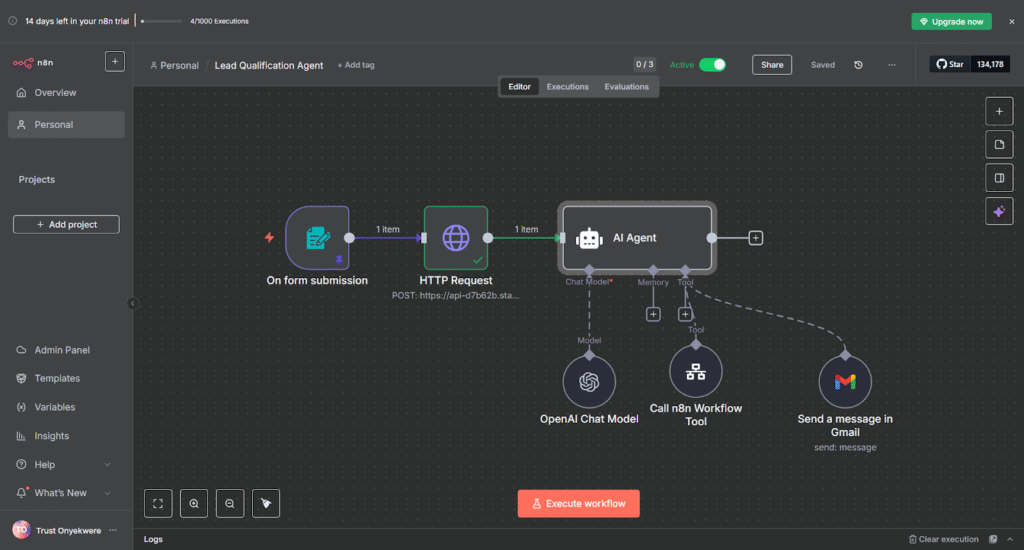
📷 Figure 1: Qualifier workflow — evaluates leads and emails them if qualified.
- On Form Submission
- Captures data from the lead submission form (name, email, company, website, budget, need, etc.).
- Captures data from the lead submission form (name, email, company, website, budget, need, etc.).
- HTTP Request
- Scrapes the lead’s website for extra context (industry, size, services).
- Scrapes the lead’s website for extra context (industry, size, services).
- AI Agent
- Uses OpenAI to evaluate if the lead is a good fit.
- The decision is based on budget, company type, and service needs.
- If the lead qualifies, the AI Agent does two things simultaneously:
- Calls the n8n Workflow Tool (Workflow 2: Notifier) to notify the business.
- Triggers the Send a message in Gmail node to email the lead directly with next steps.
- Calls the n8n Workflow Tool (Workflow 2: Notifier) to notify the business.
- Uses OpenAI to evaluate if the lead is a good fit.
This workflow ensures that qualified leads immediately hear back — no more waiting hours or days for acknowledgment.
Workflow 2: The Notifier
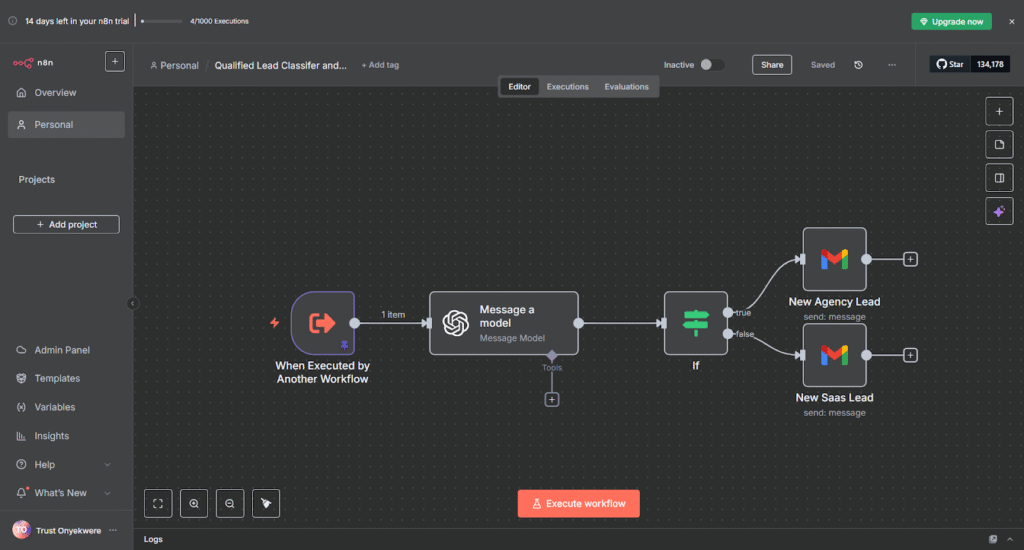
📷 Figure 2: Notifier workflow — routes leads internally to the right team.
- When Executed by Another Workflow
- Triggered by Workflow 1 whenever a lead qualifies.
- Receives the structured payload (lead info, website summary, qualification score, reasoning).
- Triggered by Workflow 1 whenever a lead qualifies.
- Message a Model (OpenAI)
- Reformats the payload into structured, professional email text for the internal team.
- Reformats the payload into structured, professional email text for the internal team.
- If Node
- Splits logic based on the lead’s type:
- If Agency → route to the Agency sales inbox.
- If SaaS → route to the SaaS sales inbox.
- If Agency → route to the Agency sales inbox.
- Splits logic based on the lead’s type:
- Send Gmail (New Agency Lead / New SaaS Lead)
- Sends the formatted lead details, qualification score, and AI reasoning to the correct sales team.
- Sends the formatted lead details, qualification score, and AI reasoning to the correct sales team.
This workflow ensures that the right internal team gets the lead instantly, so they can follow up faster with context in hand.
Results
- Instant Lead Screening
Leads are analyzed within seconds, compared to hours or days before. - Automated Follow-Up
– Leads receive a professional, AI-crafted email right away.
– Sales teams get notified with structured lead info + website summary. - Consistency
Every lead is measured against the same AI-driven criteria, removing guesswork.
Lessons Learned
- AI Agents don’t have to be complex: With tools like n8n, simple workflows can drive huge business value.
- Data enrichment is critical: Website scraping provided context that the form alone couldn’t.
- Separation of workflows improves clarity: By splitting “qualify” and “notify,” I kept logic modular and easy to adjust.
What’s Next
We plan to extend the system by:
- Adding CRM integration (HubSpot, Pipedrive, or simply Google Sheets) to log qualified leads.
- Configuring the AI to evaluate based on ICP (Ideal Customer Profile) more precisely.
- Expanding channels (Slack, WhatsApp) for instant team alerts.
Conclusion
Lead qualification no longer needs to be a time-consuming, inconsistent process. With this AI Agent built in n8n + OpenAI, I’ve shown how a task that once drained sales teams can now run in the background, faster, smarter, and at scale.
The benefits go beyond just saving time:
- Consistency – every lead is judged against the same criteria.
- Speed – follow-ups happen instantly, closing the gap between interest and response.
- Scalability – the same workflow can handle 10 leads or 10,000 without extra effort.
For sales teams, that means more time spent on real conversations and closing deals, not on manual triage. For businesses, it means fewer lost opportunities and a smoother pipeline.
This project is just one of the ways we’re experimenting at Apptalic Lab to show how AI can simplify real workflows. And this is only the beginning. From lead qualification to customer onboarding, support automation, and even internal ops, AI Agents have the potential to transform how businesses run. At Apptalic Lab, we’re exploring how these building blocks can come together to create smarter, more connected systems that make work feel effortless.